
What is the Emerson effect?
Don't miss this article; we're going to explain what the Emerson effect is and how to apply it to your indoor growing. We'll also clear up some very common mistakes that have spread through other posts, such as confusing far-red light with infrared, or talking about a supposed "near-red" that simply doesn't exist. You'll also understand how light wavelengths work and what role they play in photosynthesis of your cannabis plants.
Table of contents
- What is the Emerson effect and what does it have to do with your growing?
- Useful light spectrum for growing
- How to apply the Emerson effect in your growing
- Common mistakes about far-red light and infrared
What is the Emerson effect and what does it have to do with your growing?
In 1957, biophysicist Robert Emerson discovered that by exposing plants to light with short wavelengths (deep red, less than 680nm) and longer wavelengths (far-red, between 700-730nm), the rate of photosynthesis doesn't just add up, it multiplies. Emerson thus demonstrated that plants use two different photosystems: Photosystem II (activated by short wavelengths) and Photosystem I (activated by long wavelengths). When both work at the same time, the process is much more efficient.
And what does this have to do with cannabis? A lot. Understanding how the plant responds to different parts of the spectrum allows you to make better use of light to achieve better harvests. It's not about adding more watts, but about using light more intelligently.
After many studies and investigations that continue today, it can be confirmed that the photosynthetically active radiation (PAR) range of most plants, such as cannabis, is between 400–700 nm. Wavelengths longer than 750nm only provide heat, and may help other biological processes, but do not participate in photosynthesis in your plants.

Useful light spectrum for growing
For a plant to perform photosynthesis, it needs light, yes, but not just any light. Wavelength is what determines whether that light is useful or not for the plant. As we just said, the photosynthetically active radiation (PAR) range of our cannabis plants is between 400–700 nm. Bands below 400 nm and above 750 nm may have secondary effects that could influence quality, pigmentation, stress, plant architecture. But they cannot be considered as the main part of the "useful spectrum for photosynthesis" in the sense of biomass production and yield, at least not with current evidence.

It's common to find confusing or downright incorrect information when talking about the useful light spectrum for growing. Many posts claim that the Emerson effect is activated with "infrared light", but that's incorrect. Let's clear it up with real data.
The Emerson effect occurs when two wavelengths of the visible red spectrum are combined: deep red (around 660–680 nm) and far-red (700–720 nm). This combination simultaneously activates the plant's two photosynthetic systems (PSII and PSI), increasing photosynthesis efficiency.
Above 750 nm we enter the near infrared (IR-A), which does not participate directly in photosynthesis and translates mainly to heat. Some luminaires include IR LEDs to generate heat or stimulate secondary processes, but they are not involved in the Emerson effect.
So now you know, if you're looking to apply this effect, what you need is not "infrared light", but red light combined with far-red. And if you see a Growing LED Spotlight that says "IR" but doesn't specify the wavelength, ask for the data: if it's over 750 nm, it probably only provides heat.
Next, we leave you with a table to help you understand how wavelengths are divided, and how they are classified according to their energy and their effect:
Summary of useful wavelengths
| Range (nm) | Name | Visible? | Use in growing |
|---|---|---|---|
| 100–280 | UV-C | No | Not useful, germicidal |
| 280–315 | UV-B | No | Can increase resin, limited use |
| 315–400 | UV-A | No | Activates secondary metabolic processes |
| 400–495 | Violet / Blue | Yes | Vegetative growth |
| 495–620 | Cyan / Green / Yellow / Orange | Yes | Canopy penetration, signalling |
| 620–680 | Red | Yes | Photosynthesis, flowering, Emerson effect |
| 700–750 | Far-red | Partially | Activates PSI, regulates photoperiod, Emerson effect |
| 750–1400 | Near infrared (IR-A) | No | Generates heat, no photosynthesis |
How to apply the Emerson effect in your growing
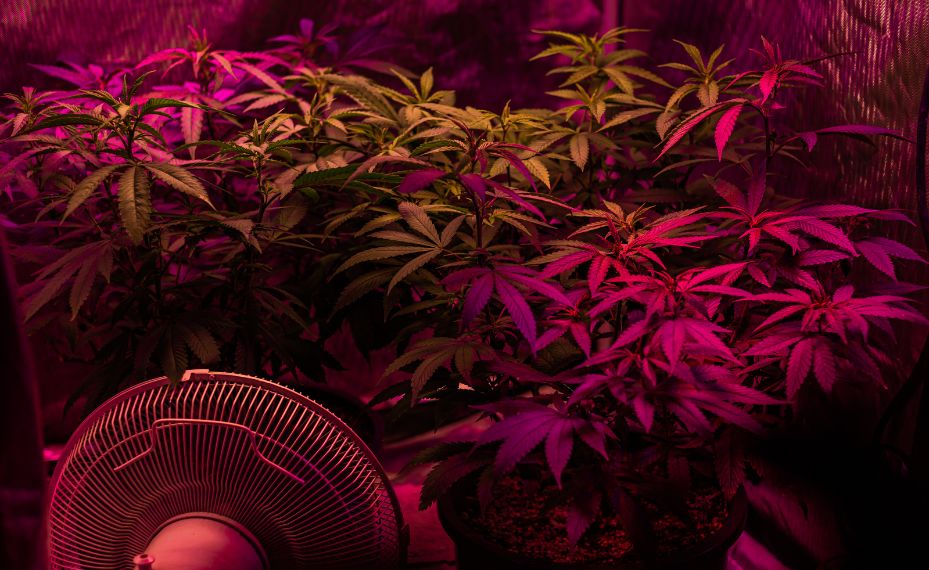
The key is to use Growing LED Spotlights with extended spectrum or add auxiliary lighting bars with far-red light. You don't need to change your entire lighting system, but you should check whether the lights you're using already include these ranges or if you can add them easily.
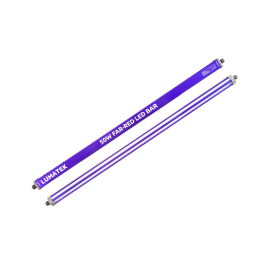
The simplest way to apply it is to use an additional light source that emits in both spectra, in the deep red spectrum and in the far-red spectrum and programme it to switch on about 15 minutes before the main photoperiod begins and switch off about 15 minutes after. This way, you simulate a gradual sunrise and sunset, and gradually activate the two photosystems. At Growlobby we have in our catalogue the Lumatek Far Red Bar 50W that works in both spectra simultaneously so you can incorporate it into your growing with one click, it's super easy to install and will help you create that sunrise and sunset environment and accompany your plants with your main light to improve their photosynthesis.
Is this technique worth applying?
It depends on your situation. If you're just starting out, you probably have more urgent things to attend to first. But if you have a controlled environment, you already know your varieties well and want to fine-tune your growing even more, adding this part of the spectrum can give you a boost in yield and quality.
Common mistakes about far-red light and infrared
One of the most widespread mistakes in articles about the Emerson effect is referring to "infrared" as if it were synonymous with "far-red". It's not.
- Far-red light has an active role in photosynthesis, activating Photosystem I.
- Infrared light (even longer wavelengths) generates heat, but does not participate directly in photosynthesis.
There is also no such thing as a term "near-red", although it's used incorrectly in many articles we've come across about this effect. The Emerson effect refers to the visible red spectrum (620–750nm), specifically two particular wavelengths: deep red (between 660–680 nm) and far-red (between 700–720 nm).
Conclusion
The Emerson effect is a scientifically proven phenomenon that can be applied easily in indoor growing. It's just a matter of understanding how the plant responds to each wavelength and slightly adjusting the on/off timing of the lights to achieve a more efficient light cycle. If you're becoming expert in the ins and outs of growing and use appropriate spectra, especially during flowering, you'll be able to notice a real difference in your harvest results using this effect.


Comments
No comments yet — be the first.