
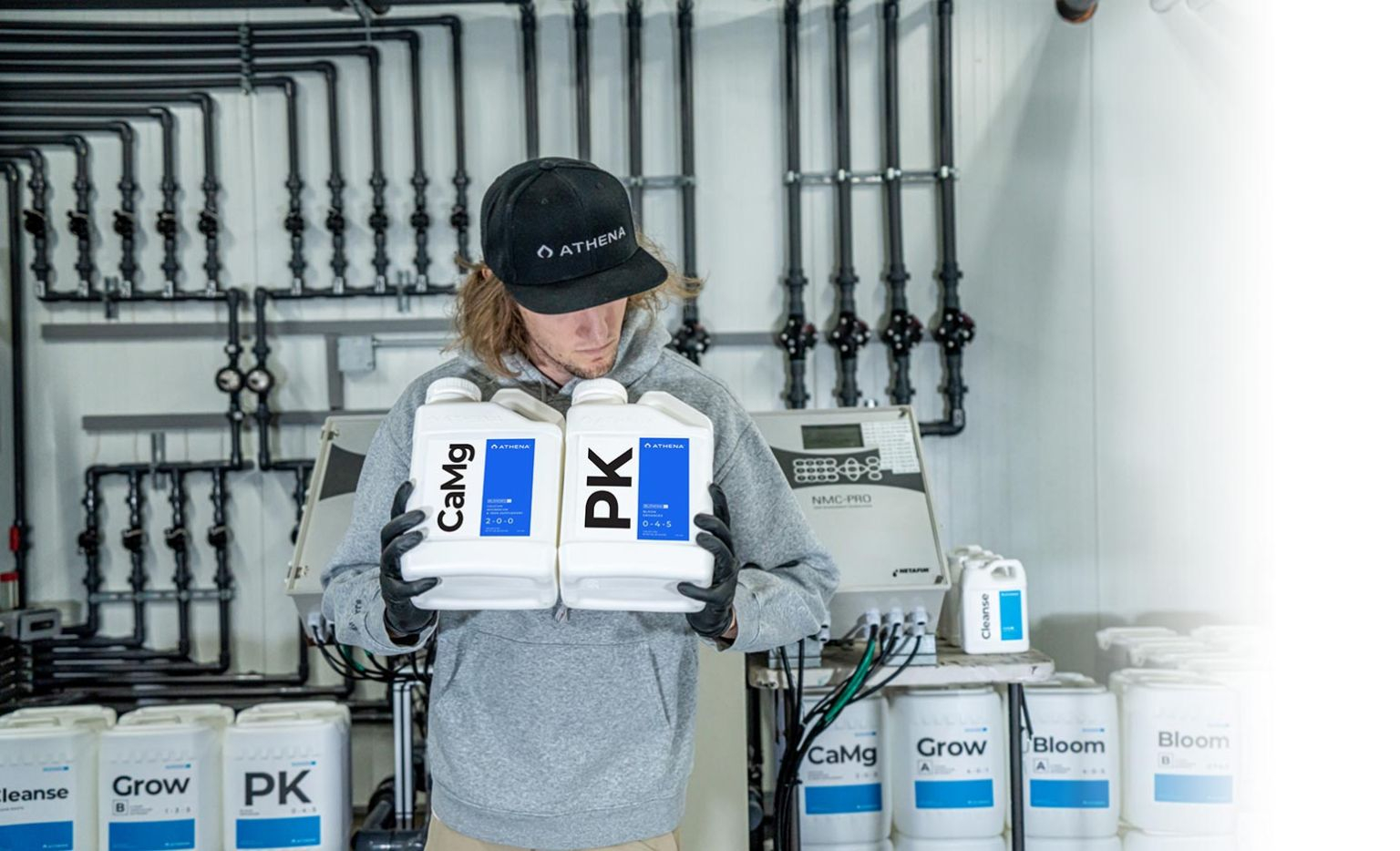
How to grow with Athena? Part 2
Key Considerations Before Growing with Athena:
1. Why Such High ECs?
It's a question everyone asks when they see that the recommended EC is 3.0 in the Proline range.
The team at Athena explains that their mineral salts have precisely the elements needed to optimise cannabis plant nutrition. In other words, there's nothing your plants won't benefit from.
Keep in mind that for your plants to feed well, the most important thing is environmental control. If you're unable to maintain your environmental parameters in the correct range, it's better to opt for the blended line with lower EC levels.
2. Climate Control [Pages 124-125 of the Manual]
For your plants to feed properly, it's essential to maintain your environmental parameters in the correct range. If you're unable to do so, use the blended line:


Although you can follow Athena's recommendations, during the final two weeks of flowering a humidity of 50 to 60% is too high for the flower density produced with this programme. With RH of 50 to 60%, the likelihood of botrytis increases significantly. We at Growlobby recommend keeping it below 50%. A value of 40-45% is perfect for the final weeks, although you'll need to use equipment to achieve this. Check the dehumidifiers section for more information.
3. Adapt These Guidelines to Your Genetics and Growing Medium.
The EC and pH guidelines given in this article are a starting point. You don't have to follow everything to the letter. You'll likely need to make some adjustments to pH and EC depending on your runoff, which is why it's essential to use a good pH and EC meter. We'll explain how to do this later.
Not all genetics feed the same. Growing in 7 litres is not the same as growing in 20 litres. Not all lights have the same spectrum. No two rooms are identical. Adapt and modify throughout your grow.
4. Irrigation Strategies.
By irrigation strategy, we mean the set of tactics we use for watering. This is: when, how much, and how to water.
In this post we're not going to cover precision irrigation strategy (used in crop steering). It's the most sophisticated irrigation strategy of all and you'll find the basics in the Athena manual. If you have a sophisticated grow with substrate sensors and want to use this system, you can read in the following manual:
https://issuu.com/athenaag/docs/athena_hb_me_es
If you have any questions, you can contact the Athena team. They'll resolve your questions and problems instantly.
We're going to explain normal hand watering or automatic irrigation, without substrate sensors.
5. Genetics Selection.
Some genetics don't work as well with this programme but are incredible in an organic grow.
The genetics that work best with this programme are American genetics that feed heavily, which is why below we've left you with some of the best varieties, especially those from Beanfiendz.
6. Growing Medium
Athena is compatible with growing substrates such as coco, soil and rock wool.
The most complex medium for the user is rock wool. This article is not aimed at growers using rock wool.
We recommend growing in coco fibre substrates as it's the least demanding medium and you'll find it the easiest to work with. Never add perlite to coco if you're going to grow with Athena.
How to Grow with Athena Using Hand Watering?
The first thing you need to know if you're watering by hand is that with proline and blended line you water the same way. That is, the irrigation strategy is the same but with different EC (they differ in EC, but the answer to when and how much to water is the same in both lines).
Above we've explained the differences between the two lines, the choice is yours. Below we show the pH and EC tables for both lines.
Hand Watering Strategy
The key to hand watering is to water once a day and wait 24 hours for it to dry out enough to water again. The process of the growing medium drying out between waterings is known as "dryback".
In the hand watering strategy, you only water once a day, you don't want to and shouldn't water multiple times a day.
For proper dryback, we need to choose the right pot size and plant spacing.
Athena recommends the following:

How Do We Measure a Correct Dryback Without Substrate Sensors?
Without substrate sensors, you can measure dryback as you always have, by weighing the pot. It's impossible to weigh them all; if the room is well designed, the plants will have fed similarly.
This system for measuring dryback is not optimal, but without a substrate sensor, it's what we've got.
It's advisable to buy a substrate sensor to measure the water content of the medium and make more precise waterings. But let's be realistic, most of us don't have one. We've seen that exceptional flowers can be produced without these sensors.

What pH and EC Should We Use?
In the following table you'll find baseline guidance for the recommended EC and pH for the programme. You may need to adjust these parameters to suit your genetics and growing conditions.
Blended Line
Hand Watering in the Vegetative Stage
In this phase of the grow we should try to encourage generative growth, we shouldn't have very aggressive drybacks. When you weigh the pots, they shouldn't be very light.
The mixture in the watering reservoir in order will consist of:
- Balance: it's the traditional pH up. It's added first because if you add it at the end there's a risk that some salts will precipitate. Here's a trick. The first time you water you won't know how much balance you need to add to reach the correct pH. To do this, the first time you make the mixture, you'll need to add balance gradually at the end until you reach the optimal pH. Measure the amount of balance you've added and the next time you fill the reservoir, start by adding the same amount of balance.
- Grow A & B
- Athena CaMg: the traditional cal-mag.
- Cleanse: it's hypochlorous acid. With the Athena programme, you want to have a sterilised growing medium. This product is used for that. Cleanse increases the redox potential of the water to its perfect range, eliminating pathogens and fungi from the growing medium.

Hand Watering During Flowering
This phase can be divided into 3 sub-phases.
- Stretch: these are the first three weeks of flowering. The intention in this phase is to encourage generative growth, meaning we're looking for more aggressive drybacks, with less runoff. The aim is to let the substrate dry out more than in the vegetative phase and thereby increase the EC of the medium.
- Bulk: normally this phase runs from the fourth to the sixth week of flowering, both inclusive. Here we're looking for vegetative growth, meaning drybacks will be less aggressive and runoff slightly higher.
- Finish: once again we're looking for generative growth. We're going to water less, gradually decreasing the EC. We also want to lower the temperature and humidity in the room to put some stress on the plants so they can express their full genetic potential.
The mixture in the watering reservoir during the flowering phase in order will consist of:
- Balance
- Bloom A & B
- Athena PK: from the third week until the end of flowering.
- Athena CaMg: used until 2 weeks remain before finishing.
- Fade: used in the final two weeks of flowering replacing Bloom A and Bloom B.
- Cleanse: used throughout flowering.
Pro Line
Hand Watering in the Vegetative Stage with the Pro Line
In this phase of the grow we should try to encourage generative growth, we shouldn't have very aggressive drybacks. When you weigh the pots, they shouldn't be very light.
The mixture in the watering reservoir in order will consist of:
- Pro Balance: it's the traditional pH up. Follow the same strategy as in the Blended line. Add it to the reservoir first and mix thoroughly to eliminate the risk of salt precipitation. The first time you make the mixture, add Pro Balance gradually until you reach the correct pH. Track how much product you've added so you know how much you'll need next time you fill the reservoir and start by adding that same amount.
- Pro Grow
- Pro Core
- Cleanse

Hand Watering During Flowering with the Pro Line
This phase can be divided into 3 sub-phases that have already been explained:
- Stretch: Corresponds to the first three weeks of the flowering phase. The objective in this period is to induce generative growth, which involves applying more intense drybacks and reducing runoff. The idea is to allow the substrate to dry out more than in the vegetative phase to increase the EC of the environment.
- Bulk: This phase generally spans from the fourth to the sixth week of flowering, both weeks inclusive. In this case, we're aiming to promote vegetative growth, which means less intense drybacks and slightly higher runoff.
- Finish: In this stage, we're back to encouraging generative growth. Reduce the frequency of watering and gradually decrease EC. Additionally, aim to lower the temperature and humidity in the environment to generate a certain level of stress in the plants, allowing them to fully express their genetic potential.
The mixture in the watering reservoir during the flowering phase in order will consist of:
- Pro Balance
- Pro Bloom
- Pro Core
- Fade: used only in the final two weeks of flowering replacing pro core.
- Cleanse
As you can see in the tables, with the blended line, you'll need to modify the EC throughout the grow. With the proline this isn't the case; the pH remains stable until the final two weeks, when you'll need to gradually decrease the EC.
How Much Should You Water?
This will depend on the size of your pot and the conditions of your room.
The important thing is to have between 10 and 25% drainage. For example, if you water one litre to a plant, you should have between 100 and 250 ml of drainage.
When Should You Water?
You should water during the day. Ideally, at the start, no later than two hours after the lights turn on.
pH and EC of the Runoff
In addition to measuring the pH and EC of your watering solution, you should measure the pH and EC of the runoff.

Why Measure pH with Athena?
Extract taken from Athena's Instagram:
"A runoff pH higher than the input solution generally means that the plant is using nutrients, especially nitrogen, efficiently. This usually occurs during the vegetative growth stage and the beginning of flowering and is a sign of normal, healthy plant development.
On the other hand, a lower runoff pH indicates that there are problems in the root zone. In general, a low runoff pH indicates that the plant is having difficulty utilising nutrients in the root zone. Possible problems could be pathogens such as fusarium or pythium in the root zone. Lower runoff pH usually occurs when the root zone is too wet and roots are submerged in excess moisture, which can cause their deterioration.
Any organic matter in the root zone can exacerbate pH fluctuations and should be avoided. Another way to prevent low runoff pH and root zone problems is to use an oxidant such as our hypochlorous acid product, Cleanse. Oxidants increase the oxidation-reduction potential (ORP) in the root zone and keep conditions clean and stable."
What EC Should the Runoff Have?
Runoff EC is measured to know what EC you should aim for in your next watering. If it's coming out lower than the target in the following tables, increase the EC of your next watering slightly.


How to Grow with Athena Using Automatic Watering?
The simplest approach would be to use the hand watering strategy. That is, water once a day and wait a day for the substrate to dry before watering again. You can do this, and it will work well for you, but you won't get the best results.
One reason you won't get the best results with the previous strategy is that you'll need to use a pot that's too large to be able to water just once a day.
With smaller pots in coco, you'll get better results. But if you use smaller pots, you'll need to water several times a day.
Undoubtedly, the best recommendation is to use smaller pots and programme your watering so there are multiple watering events per day.
Athena Recommends the Following Plant Spacing:

The most common option seen in grows is the last one. 7-litre pots and 9 plants per 1.2x1.2 / 1.5x1.5.
For this you'll need to water several times a day. To differentiate the phases of daily watering, Athena distinguishes between P1, P2 and P3.
- P1 is the first phase of watering that starts two hours after the lights turn on. In this phase, you water until the medium is saturated and you have sufficient runoff depending on the stage of growth you're in (more runoff in generative growth and less runoff in generative growth).
- P2 is the maintenance phase. In this phase you aim to keep the medium saturated to the maximum. You'll achieve this by watering 1 to 3 hours after your last P1 watering. Depending on how much your plants are feeding you'll need to water more or fewer times in the P2 phase.
- P3 is the drying period between the last watering and the first watering of the next day. In English it's known as "dryback".
How to Mix Athena Pro Line?

Conclusion
Athena is not just for professional growers or those with automatic watering. You can also use it with hand watering without being a professional.
Furthermore, they have a team of growers who will answer all your questions.
Keep in mind that this blog post is a summary of the manual they've developed from the Athena team. If you're interested in learning more, you can find it at the following link:
https://issuu.com/athenaag/docs/athena_hb_me_es
Comments
No comments yet — be the first.