

Biobizz chart 2025
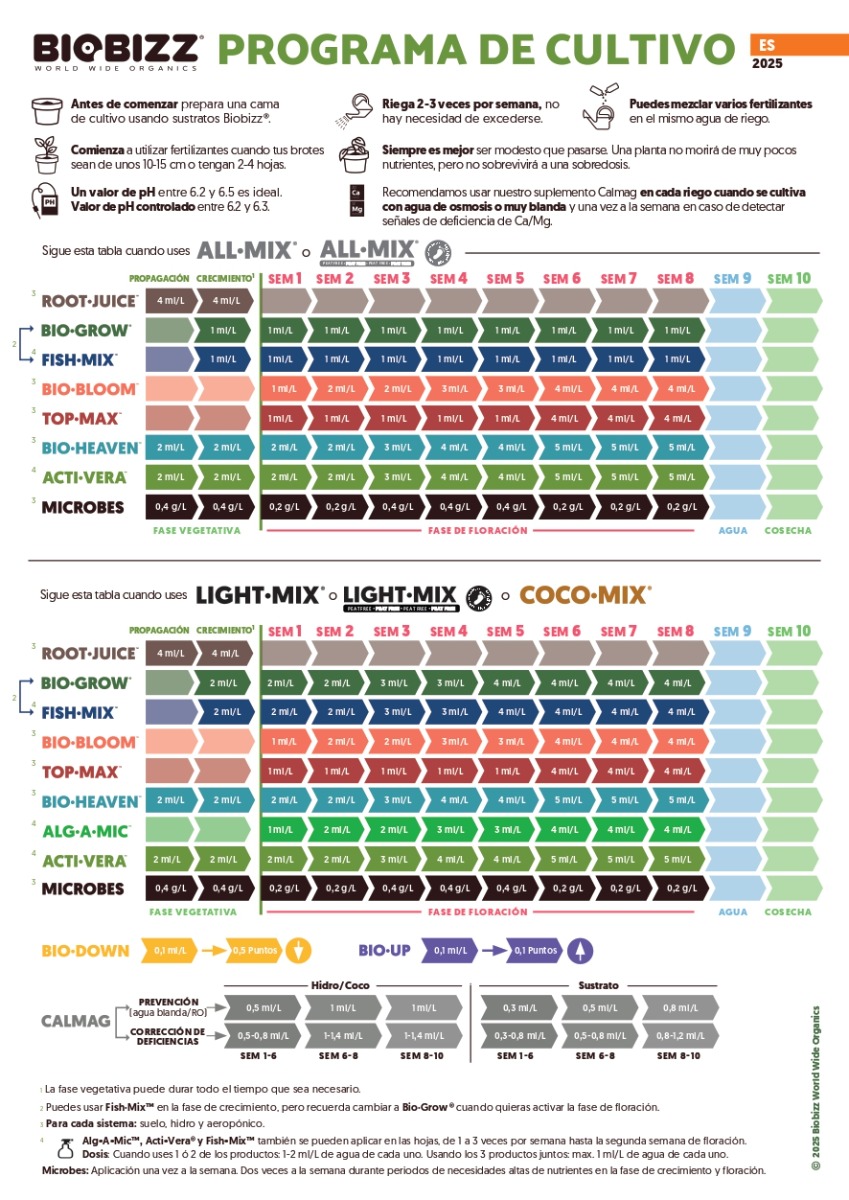
The new BioBizz 2025 growing chart is an official guide to get the most out of their range of organic fertilisers. However, simply following numbers doesn't always give good results; you need to understand what each product provides and when it's best to apply it.
In this article we break down the BioBizz chart step by step and tell you the most common mistakes so you don't repeat them and your crop reaches the end with healthy plants and an incredible harvest.
Table of contents
BioBizz 2025 Growing Chart
How to interpret the BioBizz growing chart
At the top of the chart, BioBizz has written some basic details and tips for using it correctly, here's a summary:
- Start using fertilisers when seedlings are between 10–15 cm or at least 2–4 true leaves.
- Less is more: overdosing can kill the plant, whilst slight deficiency is easily corrected.
- Water 2–3 times per week, avoiding waterlogging.
- Control pH at 6.2–6.5; if you don't adjust it, nutrients won't be absorbed properly.
- They recommend using CalMag supplement with each watering when growing
with reverse osmosis or very soft water and once a week if you notice
signs of Ca/Mg deficiency
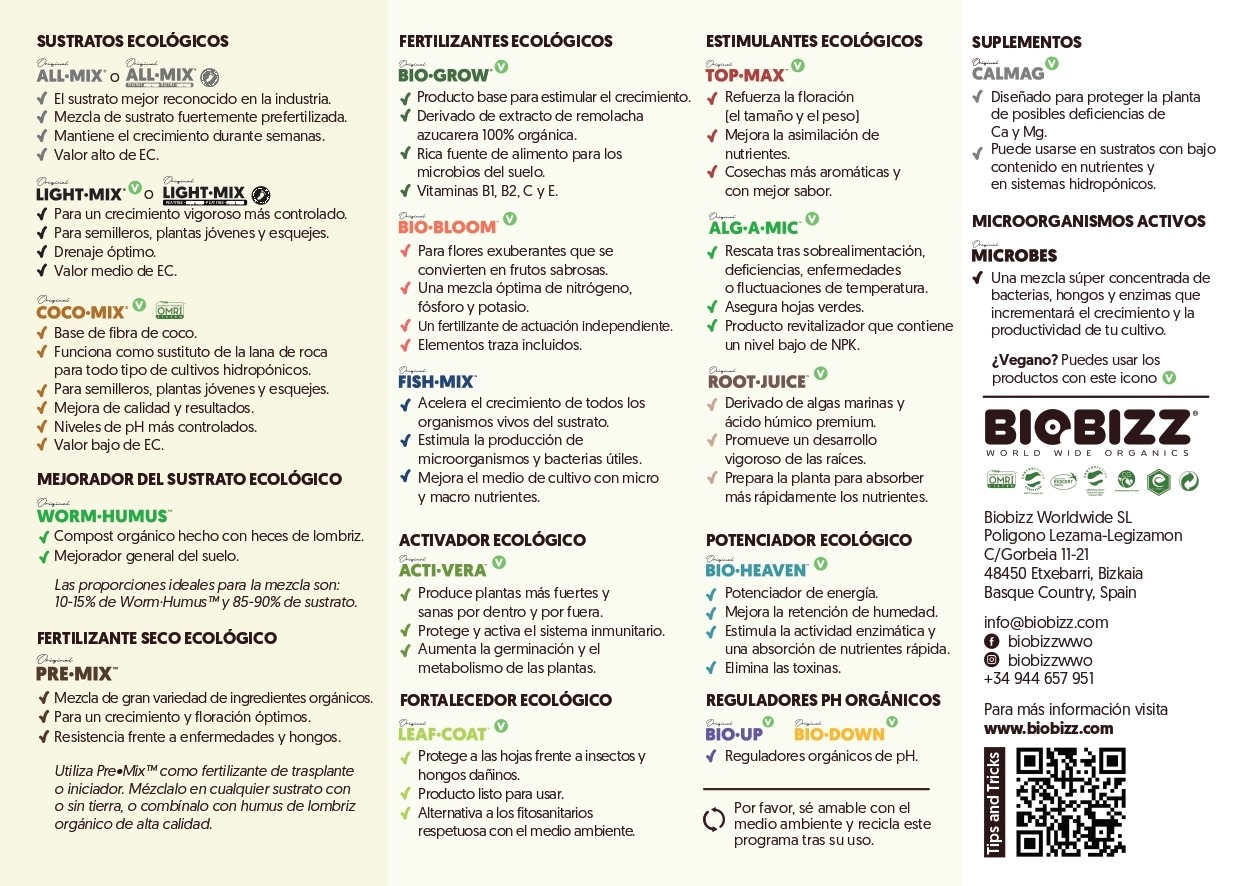
BioBizz chart products
Rather than an endless list, here's a practical breakdown of what each fertiliser does and how it fits into the BioBizz growing chart in each of its phases:
| Product | Key moment | Main function |
| Fish·Mix | Growth |
Provides vigour, stimulates microorganisms. Replaced by Bio·Grow when flowering starts. |
| Bio·Grow | Transition and flowering |
Nutritional base rich in sugars, keeps the plant active. |
| Bio·Bloom | Flowering | Blend of NPK and micronutrients. Dosage increases through pre-flowering, bulking and maturation. |
| Top·Max | Flowering | Booster of nutrient uptake and flower development. Improves flavour and aroma. |
| Alg·A·Mic and Acti·Vera | Throughout the cycle | Strengthen defences, reduce stress. Also applicable via foliar spray until week 2 of flowering. |
| Microbes | Throughout the cycle | Once a week (twice if high demand). Increases microbial activity. |
| CalMag | Throughout the cycle | Essential with reverse osmosis or soft water; prevents calcium and magnesium deficiencies. |
BioBizz chart: Most common mistakes and how to avoid them
This is where growers most often go wrong when applying the chart:
- Fertilising too early
Newly-sprouted seedlings don't need fertilisers. If you rush, you'll burn roots. Consider the type of substrate you've chosen when starting to use fertilisers; some come pre-prepared for the growth phase and need barely anything else. Be careful and don't overfeed plants in their first weeks of growth. - Not measuring pH
The ideal range (6.2–6.5) is not optional. Without control, you'll get lockout and deficiency symptoms even if you fertilise correctly. Use a pH meter like the Hanna GroPro pH Meter and save yourself headaches. - Overdoing the dosages
Using more ml/L than recommended doesn't speed anything up. The opposite: it locks the soil and slows the plant. Better to err on the side of caution, be precise and use measuring tools matched to your needs. - Forgetting CalMag in soft water
One of the most common deficiencies in reverse osmosis grows. It's easily corrected, but many ignore it. Don't forget and you'll notice the difference in your harvests. - Skipping the final flush
Last two weeks water only. If you don't do this, flavour and harvest quality will suffer.
Adjust the BioBizz chart to your grow
The BioBizz chart is a standard guide, but every grow has its nuances. Here are some examples of adjustment:
- Substrate:
- BioBizz Light Mix: start fertilising sooner because the substrate has barely any nutrients.
- BioBizz All Mix: delay fertilisers in the first few weeks.
- Autos and fast: reduce vegetative weeks. Some flowering phases overlap, so don't follow the chart rigidly.
- Hard vs soft water: with hard water you can slightly reduce dosages to avoid salt buildup.
- Coco or hydro: dosages are more frequent and constant; check the specific chart for these systems.
- Foliar application: using Alg·A·Mic, Acti·Vera or Fish·Mix on leaves up to the second week of flowering gives an extra boost to resilience and nutrient uptake.
BioBizz Chart Conclusion
The BioBizz 2025 chart works as a reliable roadmap, bearing in mind that it's also flexible, not a fixed recipe. The key is to watch your plants, adjust on the fly and avoid the typical mistakes of overdosing or neglecting pH.
With the chart as your foundation and a close eye on your grow, you'll see how your organic harvests can reach their full potential.
Comments
No comments yet — be the first.